Apparently the Katie Couric vice-presidential interviews crossed paths with our class this week. Watch and learn (?), as you get ready for tonight's debate (The Donnybrook on Delmar! The Skunking on Skinker!) at Wash. U. in St. Louis:
Palin actually makes a halfway decent point about Jefferson at the beginning of her answer, about on par with Couric's poor quotation, then goes downhill from there.
Thursday, October 02, 2008


Monday, September 29, 2008
WWJS?
What would Jefferson say, I mean, about this?
Pastor Luke Emrich prepared his sermon this week knowing his remarks could invite an investigation by the Internal Revenue Service. But that was the whole point, so Emrich forged ahead with his message: Thou shalt vote according to the Scriptures.
"I'm telling you straight up, I would choose life," Emrich told about 100 worshippers Sunday at New Life Church, a nondenominational evangelical congregation about 40 miles from Milwaukee.
"I would cast a vote for John McCain and Sarah Palin," he said. "But friends, it's your choice to make, it's not my choice. I won't be in the voting booth with you."
All told, 33 pastors in 22 states were to make pointed recommendations about political candidates Sunday, an effort orchestrated by the Arizona-based Alliance Defense Fund.
The conservative legal group plans to send copies of the pastors' sermons to the IRS with hope of setting off a legal fight and abolishing restrictions on church involvement in politics. Critics call it unnecessary, divisive and unlikely to succeed.
Congress amended the tax code in 1954 to state that certain nonprofit groups, including secular charities and places of worship, can lose their tax-exempt status for intervening in a campaign involving candidates.
Erik Stanley, senior legal counsel for the Alliance Defense Fund, said hundreds of churches volunteered to take part in "Pulpit Freedom Sunday." Thirty-three were chosen, in part for "strategic criteria related to litigation" Stanley wouldn't discuss.
Pastor Jody Hice of Bethlehem Baptist Church in Bethlehem, Ga., said in an interview Sunday that his sermon compared Democrat Barack Obama and Republican John McCain on abortion and gay marriage and concluded that McCain "holds more to a biblical world view."
He said he urged the Southern Baptist congregation to vote for McCain.
"The basic thrust was this was not a matter of endorsing, it's a First Amendment issue," Hice said. "To say the church can't deal with moral and societal issues if it enters into the political arena is just wrong, it's unconstitutional."
There's more here.
In answering this, don't jump to conclusions. Think about Jefferson's writings on religion and politics and the Constitution from your reading so far, and supplement them with this 1798 letter to John Taylor and his famous reply to the Danbury Baptist Association.
Wednesday, September 24, 2008
Are you enlightened?
My apologies for forgetting to post this last week. Here are a couple of questions to consider and answer as you finish going through the Enlightenment Reader: The Enlightenment is considered a cornerstone of modern thought. What Enlightenment principles do we still live by? Do any seem to have been abandoned?
Wednesday, September 10, 2008
Gentility, Lobbying, and Corruption
We need to move on in the course, so I think I will not be addressing in lecture one of the important political practices that gentility helped foster. I explain it much better in print anyway, and we can discuss it here. So, just to make sure everyone gets the point, please read the assigned article on lobbying in the Early Republic and answer these questions: How did the culture of gentility pave the way for the beginnings of lobbying in the United States? Do the activities of men like the Rev. Manasseh Cutler and William Duer right in their midst indicate that the Founders had a bit of a corruption problem? The first question has a definite answer, the second leaves more room for your own interpretation.
Monday, September 08, 2008
"Deference" in the news
Just wanted to alert my students to a post on my other blog about a concept we discussed last week, "deference." Apparently the "natural aristocracy" is alive and well, at least in their own minds.
Sunday, September 07, 2008
Duelling for Fun and Friendship
Linked here is the one version of the "code duello," or the rules that American duellists used in the era of the Founders. While the most famous duels were between politicians and military officers, the code could also be used to deal with minor or major verbal disputes of any kind among gentlemen, including college students. Please read it and consider: Was this a brutal and unreasonable system? What would be the impact in your social circle if people knew they might have to stand and be shot at from 30 feet away across an open field, for treating someone inconsiderately or criticizing them to others?
OTHER RESOURCES: PBS has a good brief history of dueling in American here. A site called How Stuff Works has a surprisingly good explanation on how duelling operated, including but also going beyond early America. A brief history of the Burr-Hamilton duel, and images of the site and the letters leading up the encounter, appear in "Interview at Weehawken."
Any particular duel would make a great paper topic, though if Burr and Hamilton is your interest I would probably make you pick some aspect of their lives or relationship rather than the duel itself.
OTHER RESOURCES: PBS has a good brief history of dueling in American here. A site called How Stuff Works has a surprisingly good explanation on how duelling operated, including but also going beyond early America. A brief history of the Burr-Hamilton duel, and images of the site and the letters leading up the encounter, appear in "Interview at Weehawken."
Any particular duel would make a great paper topic, though if Burr and Hamilton is your interest I would probably make you pick some aspect of their lives or relationship rather than the duel itself.
Wednesday, August 27, 2008
Jefferson and Adams on the "Natural Aristocracy"
After their presidencies, Thomas Jefferson and John Adams renewed the friendship had been strained just a bit by competing against each other in two presidential elections. Adams won in 1796, Jefferson came back and beat him in 1800. They carried on a long-distance philosophical discussion that continued until nearly the end of their lives. One point they realized they agreed on was that America and all other societies had a "natural" aristocracy, and that the goal of any good political system should be to see that such natural aristocrats controlled the powers of government. Here's Jefferson, from a letter I will quote in class:
Directing this question to my students, what do you think, did these Founders really favor an aristocracy? Are Jefferson's and/or Adams's consistent with American democracy as you understand it?
For I agree with you that there is a natural aristocracy among men. The grounds of this are virtue and talents. Formerly bodily powers gave place among the aristoi. But since the invention of gunpowder has armed the weak as well as the strong with missile death, bodily strength, like beauty, good humor, politeness and other accomplishments, has become but an auxiliary ground of distinction. There is also an artificial aristocracy founded on wealth and birth, without either virtue or talents; for with these it would belong to the first class. The natural aristocracy I consider as the most precious gift of nature for the instruction, the trusts, and government of society. And indeed it would have been inconsistent in creation to have formed man for the social state, and not to have provided virtue and wisdom enough to manage the concerns of the society. May we not even say that that form of government is the best which provides the most effectually for a pure selection of these natural aristoi into the offices of government? The artificial aristocracy is a mischievous ingredient in government, and provision should be made to prevent it's ascendancy.Read the whole thing. Adams's reply can be found online beginning here. The available copy is in Jefferson's handwriting, so you may need to use the link on each page that brings up a larger, higher-resolution image. Don't worry about the many historical references and ancient-language quotations in these letter unless you want to.
Directing this question to my students, what do you think, did these Founders really favor an aristocracy? Are Jefferson's and/or Adams's consistent with American democracy as you understand it?
Tuesday, August 26, 2008
Welcome 2008 students
Watch this space for more, but for now here is this year's syllabus, with a few corrections from the one posted on the main site.
Sunday, May 07, 2006
Review sheet for final
I forgot about this over the week-end, but the final review sheet is now up on the main course web site.

Wednesday, April 19, 2006
Friday April 21 lecture cancelled -- discuss the Whiskey Rebellion here
I have to go out of town on Friday for a last-minute meeting. Because of the small amount of time we have left, I am posting the complete lecture notes for the next topic, "1794: The Year of the Gun." Please read these along with Thomas Slaughter's book on the Whiskey Rebellion. Those who need to boost their participitation/attendance scores may post comments or questions on the book and lecture here. Consider the question: Do you find the Whiskey Rebellion to be the crucial turning point in American history that Slaughter makes it out to be? Why or why not?
Thursday, March 16, 2006
The Great Sally Hemings Debate
As I explained in class, by next Monday March 29, please read Annette Gordon-Reed's Thomas Jefferson and Sally Hemings and Jefferson's writings on race and slavery. Then prepare yourself for a little debate. Students with last names beginning with A-L should prepare to take the "guilty" side of the question, last names M-Z the "not guilty." The graduate students can be the jury and ask questions and help decide the penalty if the verdict is guilty.
Students are free to organize themselves and appoint spokespeople, or I will just call on people. Students who are more comfortable with writing or can't come to class can answer in the comment thread below.
Students are free to organize themselves and appoint spokespeople, or I will just call on people. Students who are more comfortable with writing or can't come to class can answer in the comment thread below.
Friday, March 03, 2006
Midterm Questions
If there are any questions about the mid-term, please post them here as comments. Someone already e-mailed me to ask about citing lecture notes. Yes, you may do that. Cite the lectures parenthetically as follows: (Class lecture, 3/2/06), changing the date to the correct one. If are citing directly off one of the outlines, which I do not recommend, cite the outline title and date in a footnote or endnote.
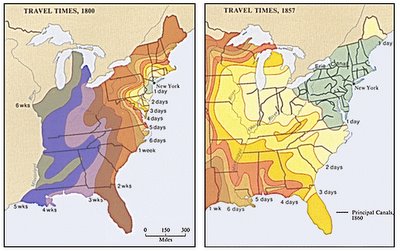
Map related to this morning's lecture
This morning when I was discussing the difficulty of travel in early America, I had meant to display the following map show the estimated travel time before and after the transportation revolution of the mid-19th century.

Wednesday, February 22, 2006
Midterms postponed a week
Just so we can we have the mid-term at the thematic break-point of the course, I am going to postpone the tests a week. This means that the take-home will be distributed on Friday, March 3 (due March 10) & the in-class will be held Monday, March 6.
Friday, February 17, 2006
General interest from TomPaine.com
Regaining Our Common Sense
Harvey J. Kaye
January 10, 2006
http://www.tompaine.com/articles/2006/01/10/regaining_our_common_sense.php
Harvey J. Kaye is professor of social change and development at the University of Wisconsin-Green Bay and the author of Thomas Paine and the Promise of America (Hill and Wang, 2005).
The 230th anniversary of the publication of Thomas Paine’s Common Sense—the brilliant little pamphlet whose arguments literally turned the world upside down— invites reflection both on the state of the nation to which it gave birth and on the state of the left to which it gave rise and whose many generations carried on the fight to realize the democratic vision rendered in its pages. Recalling Paine’s work should serve, as well, to remind us of not only what we stand in opposition to, but also what we stand in opposition for. And ultimately we might ask, “What would Tom Paine do?”
Born in 1737, the son of an English Quaker artisan and an Anglican mother, Paine had a career before coming to Philadelphia in 1774 that included corsetmaking, privateering, tax collecting, preaching, teaching, labor campaigning and shopkeeping, punctuated by bouts of poverty, the loss of two wives, business bankruptcy and dismissal from government service (twice!). And yet as much as he came to despise kingly rule, aristocratic privilege and religious establishments for their oppression, exploitation and corruption, Paine did not pick up his pen to assail Crown, Constitution and Empire out of anger alone.
It was his love for America that turned Paine into a radical writer. Struck by the country’s prospects and possibilities, and moved by the spirit and determination of its people to resist British authority, Paine devoted himself to the American cause. And through Common Sense and his later Crisis Papers , he emboldened his new compatriots to turn their rebellion into a revolutionary war, defined the new nation in a democratically expansive and progressive fashion, and articulated an American identity charged with exceptional purpose and promise.
Sincerely believing that, “The sun never shined on a cause of greater worth,” Paine translated American anxieties and aspirations into a powerful cry for independence. But it was never simply a matter of separating from Britain.
Paine’s own experience—reinforced by what he witnessed in America— convinced him that working people, not just the highborn and propertied, had the capacity both to comprehend the world and to govern it. And by addressing his arguments not merely to the governing elites, but all the more to those who traditionally were excluded from political debate and deliberation, he transformed the very idea of politics and the political nation.
Utterly rejecting the old political and social order and pressing for national unity, Paine called for an American constitution—empowered by the people— that would create a democratic government and guarantee freedom to all, and above all else freedom of conscience and worship (which, he clearly stated, required separating church and state). And in that spirit he projected an Independence Day filled with splendid democratic ritual:
"[L]et a day be solemnly set apart for proclaiming the charter; let it be brought forth placed on the divine law, the Word of God; let a crown be placed thereon, by which the world may know, that so far as we approve of monarchy, that in America THE LAW IS KING. But lest any ill should afterwards arise, let the crown at the conclusion of the ceremony be demolished, and scattered among the people whose right it is."
Moreover, appreciating America’s ethnic diversity, Paine foresaw the United States welcoming to its shores freedom-loving folk from all nations:
" O! ye that love mankind! Ye that dare oppose, not only tyranny, but the tyrant, stand forth! Every spot of the world is overrun with oppression. Freedom hath been hunted round the globe. Asia and Africa have long expelled her. Europe regards her like a stranger, and England hath given her warning to depart. O! receive the fugitive and prepare in time an asylum for mankind."
Declaring that, “The cause of America is in a great measure the cause of all mankind,” Paine envisioned the United States serving not only as a refuge, but also as a model, and in time a champion, of freedom and republican democracy. And possessed of tremendous confidence in his fellow citizens to be, he proclaimed that, “We have it in our power to begin the world again.”
To the chagrin of conservatives, and against their best efforts to suppress Paine’s memory, American progressives—men and women, native-born and immigrant— for two hundred years thereafter were to draw ideas, inspiration and encouragement from Paine’s life and labors as they themselves sought to extend and deepen freedom, equality and democracy.
Heartened and animated by Paine, we pressed for the rights of workers; insisted upon freedom of conscience and the separation of church and state; demanded the abolition of slavery; campaigned for the equality of women; confronted the power of property and wealth; opposed the tyrannies of fascism and communism; fought a second American Revolution for racial justice and equality; and challenged our own government’s authorities and policies, domestic and foreign. Though we regularly suffered defeats and committed mistakes, we also achieved great victories and, more often than not, transformed the nation and the world for the better.
Evidently, struggles continue. Yet something has changed. Somewhere along the way, we lost the political courage and conviction that once motivated our efforts. Arguably, we lost touch with Paine.
Clearly our own “times that try men’s souls” differ profoundly from those Paine confronted. Yet we, too, find ourselves subject to a regime that ignores the needs of working people, promotes aristocratic power and wealth, pursues imperial policies, makes religion a test for public office and places itself above the law.
Far more than simply reciting Paine’s lines and acknowledging their author, the revitalization of progressive politics demands that we redeem Paine’s radical spirit. We must reaffirm our faith in America’s great purpose and promise, recover our belief in the prospects and possibilities of democratic change and regain our confidence in our fellow citizens. For only then, Paine would surely say, might we “have it in our power to begin the world over again.”
Harvey J. Kaye
January 10, 2006
http://www.tompaine.com/articles/2006/01/10/regaining_our_common_sense.php
Harvey J. Kaye is professor of social change and development at the University of Wisconsin-Green Bay and the author of Thomas Paine and the Promise of America (Hill and Wang, 2005).
The 230th anniversary of the publication of Thomas Paine’s Common Sense—the brilliant little pamphlet whose arguments literally turned the world upside down— invites reflection both on the state of the nation to which it gave birth and on the state of the left to which it gave rise and whose many generations carried on the fight to realize the democratic vision rendered in its pages. Recalling Paine’s work should serve, as well, to remind us of not only what we stand in opposition to, but also what we stand in opposition for. And ultimately we might ask, “What would Tom Paine do?”
Born in 1737, the son of an English Quaker artisan and an Anglican mother, Paine had a career before coming to Philadelphia in 1774 that included corsetmaking, privateering, tax collecting, preaching, teaching, labor campaigning and shopkeeping, punctuated by bouts of poverty, the loss of two wives, business bankruptcy and dismissal from government service (twice!). And yet as much as he came to despise kingly rule, aristocratic privilege and religious establishments for their oppression, exploitation and corruption, Paine did not pick up his pen to assail Crown, Constitution and Empire out of anger alone.
It was his love for America that turned Paine into a radical writer. Struck by the country’s prospects and possibilities, and moved by the spirit and determination of its people to resist British authority, Paine devoted himself to the American cause. And through Common Sense and his later Crisis Papers , he emboldened his new compatriots to turn their rebellion into a revolutionary war, defined the new nation in a democratically expansive and progressive fashion, and articulated an American identity charged with exceptional purpose and promise.
Sincerely believing that, “The sun never shined on a cause of greater worth,” Paine translated American anxieties and aspirations into a powerful cry for independence. But it was never simply a matter of separating from Britain.
Paine’s own experience—reinforced by what he witnessed in America— convinced him that working people, not just the highborn and propertied, had the capacity both to comprehend the world and to govern it. And by addressing his arguments not merely to the governing elites, but all the more to those who traditionally were excluded from political debate and deliberation, he transformed the very idea of politics and the political nation.
Utterly rejecting the old political and social order and pressing for national unity, Paine called for an American constitution—empowered by the people— that would create a democratic government and guarantee freedom to all, and above all else freedom of conscience and worship (which, he clearly stated, required separating church and state). And in that spirit he projected an Independence Day filled with splendid democratic ritual:
"[L]et a day be solemnly set apart for proclaiming the charter; let it be brought forth placed on the divine law, the Word of God; let a crown be placed thereon, by which the world may know, that so far as we approve of monarchy, that in America THE LAW IS KING. But lest any ill should afterwards arise, let the crown at the conclusion of the ceremony be demolished, and scattered among the people whose right it is."
Moreover, appreciating America’s ethnic diversity, Paine foresaw the United States welcoming to its shores freedom-loving folk from all nations:
" O! ye that love mankind! Ye that dare oppose, not only tyranny, but the tyrant, stand forth! Every spot of the world is overrun with oppression. Freedom hath been hunted round the globe. Asia and Africa have long expelled her. Europe regards her like a stranger, and England hath given her warning to depart. O! receive the fugitive and prepare in time an asylum for mankind."
Declaring that, “The cause of America is in a great measure the cause of all mankind,” Paine envisioned the United States serving not only as a refuge, but also as a model, and in time a champion, of freedom and republican democracy. And possessed of tremendous confidence in his fellow citizens to be, he proclaimed that, “We have it in our power to begin the world again.”
To the chagrin of conservatives, and against their best efforts to suppress Paine’s memory, American progressives—men and women, native-born and immigrant— for two hundred years thereafter were to draw ideas, inspiration and encouragement from Paine’s life and labors as they themselves sought to extend and deepen freedom, equality and democracy.
Heartened and animated by Paine, we pressed for the rights of workers; insisted upon freedom of conscience and the separation of church and state; demanded the abolition of slavery; campaigned for the equality of women; confronted the power of property and wealth; opposed the tyrannies of fascism and communism; fought a second American Revolution for racial justice and equality; and challenged our own government’s authorities and policies, domestic and foreign. Though we regularly suffered defeats and committed mistakes, we also achieved great victories and, more often than not, transformed the nation and the world for the better.
Evidently, struggles continue. Yet something has changed. Somewhere along the way, we lost the political courage and conviction that once motivated our efforts. Arguably, we lost touch with Paine.
Clearly our own “times that try men’s souls” differ profoundly from those Paine confronted. Yet we, too, find ourselves subject to a regime that ignores the needs of working people, promotes aristocratic power and wealth, pursues imperial policies, makes religion a test for public office and places itself above the law.
Far more than simply reciting Paine’s lines and acknowledging their author, the revitalization of progressive politics demands that we redeem Paine’s radical spirit. We must reaffirm our faith in America’s great purpose and promise, recover our belief in the prospects and possibilities of democratic change and regain our confidence in our fellow citizens. For only then, Paine would surely say, might we “have it in our power to begin the world over again.”
Monday, February 13, 2006
Reading assignment in the Portable Enlightenment Reader
Here are the excerpts from Isaac Kramnick, ed., The Portable Enlightenment Reader, that you should read. Note that we have already discussed many of these thinkers in lecture, while others will come up later.
If you bog down in this material, the selections from Locke are by far the most important.
- Introduction
- Part I: selections by Kant, d'Alembert, Diderot, Dumarsais, Condorcet
- Part II: selections by Bacon, Newton, Voltaire, Condorcet, Priestley, Franklin
- Part III: selections by Locke, Shaftesbury, Newton, Montesquieu, Voltaire, Gibbon, Jefferson, Franklin, Temple of Reason, Paine
- Part IV: Mind and Ideas --selections by Descartes, Locke, Voltaire, Hume, Reid, Condillac
- Part IV: Education and Childhood -- selections by Locke, Rousseau & Priestley
- Part IV: Manners and Morals -- selections by Mandeville, Pope, Diderot, Hutcheson, Smith, Kant
- Part IV : Taste and Art --selections by Hutcheson, Rousseau, Smith, Kant
- Part V: Progress and History -- selections by Turgot, Smith, Ferguson, Priestley, Condorcet
- Part V: Politics and the State (all)
- Part V: Markets and Economcs -- selection by Hume, Smith
If you bog down in this material, the selections from Locke are by far the most important.
Wednesday, January 18, 2006
Welcome to History 4000/7000 for 2006
This blog will be my principal electronic means of communicating with students. Students will also be able to participate here by means of the comment section. You may have to register with Blogger.com in order to comment, but in any case students should use their real 1st & last names (no student numbers) in order to get proper credit for their postings.
Subscribe to:
Posts (Atom)